Aug 21, 2026Buying Guides
FAQ About Private Label Loungewear Manufacturing
Evaluate a private label loungewear manufacturer with buyer FAQs on specifications, samples, MOQ, QC, labels, packaging, and bulk release.
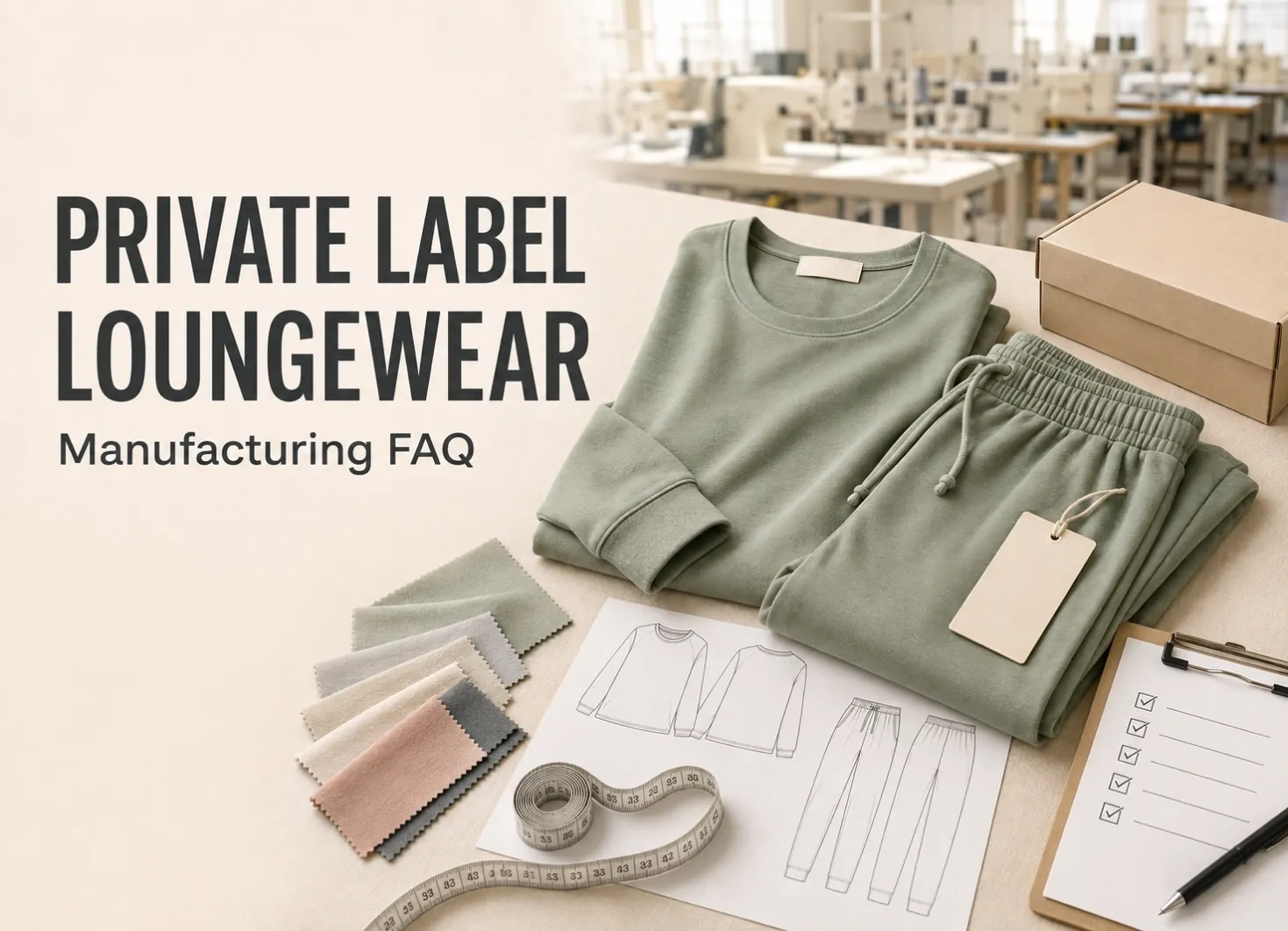
Choosing a private label loungewear manufacturer is a supplier-evaluation task: buyers need to establish whether a supplier can quote, sample, and produce the same defined product. For fashion brands, boutiques, wholesalers, Amazon sellers, importers, distributors, and hotel or spa buyers, the key is to control specifications, approvals, and packing before bulk release. This FAQ explains the questions to ask and the records to retain for a private-label loungewear order.
Quick Answer for Buyers
Buyer decision | Confirm before moving forward | Why it matters |
|---|---|---|
Product definition | Construction, fabric direction, colours, size range, and quantity split | Suppliers can quote the same configuration |
Sample gate | Measurements, workmanship, branding, and pack components | Sample approval becomes a recorded decision |
Commercial scope | MOQ basis, included components, assumptions, and exclusions | Unit prices can be compared fairly |
Bulk release | Approved version, QC checkpoints, labels, and carton marks | Open questions are less likely to reach production |
Start with Xinglaika Apparel's product range, a related women's cotton pajama set product page, or the catalog download to establish a product direction. A catalogue reference can begin a conversation, but it does not replace a tech pack or written production brief.
What Should I Send a Private Label Loungewear Manufacturer?
Send the same written brief to every supplier you want to compare. For each loungewear style, describe the garment separately from the sales image: silhouette, neckline, sleeve, shoulder, pockets, closures, waistband, hem, seam details, piping, print or embroidery, and contrast trims. Include front and back references, intended fabric composition or hand-feel, colour reference, target size range and split, estimated quantity, target market, and sales channel.
State the information that the buyer owns as well. This may include destination-market, retail-platform, import, labelling, safety, or product-compliance requirements. A manufacturer can work from the documented brief; the buyer should validate market obligations with appropriate qualified advisers. Do not assume that a generic product image, a supplier statement, or a previous order proves that a new style meets every requirement.
How Do I Compare Private Label Loungewear Quotes?
Compare scope before comparing a unit price. Use the following matrix and ask each supplier to state unanswered questions, assumptions, and exclusions in writing.
Factor | What buyers should ask | Record to retain |
|---|---|---|
Fabric | Which composition, weight, hand-feel, colour reference, care assumptions, and substitutions are included? | Approved swatch or material reference and quote assumptions |
Pattern and sizing | Which base size, points of measure, tolerance approach, and grading direction will apply? | Measurement table and dated sample comments |
MOQ and sampling | Which fabric, colour, trim, label, and pack configuration does the MOQ cover? | Project-specific quotation and sample plan |
Branding | Which logo, neck label, care label, hangtag, barcode, and artwork files are needed? | Version-controlled artwork and placement instructions |
QC | Which observable inspection points can be agreed for this order? | Order-specific QC checklist and approved reference |
Packaging | Which folding, bag or box, insert, size sticker, assortment, and carton marks are included? | Packing specification and carton-mark file |
For a fuller comparison method, use this custom sleepwear supplier comparison guide. The same principle applies to loungewear: a lower figure is not comparable if it leaves out material, branding, sampling revision, or packaging scope.
Does a Private Label Loungewear Manufacturer Need a Tech Pack?
A complete technical package reduces assumptions, but buyers can begin with organised references when a formal tech pack is not ready. Create a working specification that identifies the style version, construction notes, material direction, colour or artwork reference, measurements, grade direction, labels, and packing. Ask the manufacturer to identify missing details rather than silently choose them.
The specification should change with the sample. Number the file and sample comments. When a buyer approves a change to fit, fabric, trim, print placement, label position, or folding method, that change should appear in the current production reference. This makes the sample review useful at the later quality-inspection stage.
How Are Fabric, Trims, and Branding Controlled?
Material names alone are not a production instruction. Terms such as cotton, modal, fleece, or satin do not settle composition, weight, opacity, colour consistency, shrinkage behaviour, seam performance, or care instructions. State the intended outcome and review nominated material references against the written brief.
Branding needs the same control. Confirm the artwork version, logo dimensions, placement, label material, label language, care information supplied by the buyer, hangtag, barcode, and pack inserts. A wholesaler may require assortment information; an Amazon seller may have platform preparation details; a hotel or spa buyer may need repeat-order consistency. Describe the channel early so labels and packing can be assessed as part of the quotation.
What Is the Manufacturing Process With Xinglaika Apparel?
Xinglaika Apparel presents itself as an OEM and ODM sleepwear and apparel manufacturer for global buyers. The process below is a buyer control path, not a promise that every project has the same timing or outcome. Confirm the project-specific materials, responsibilities, and approvals before proceeding.
- Fabric selection. Provide composition, hand-feel, colour, care, opacity, and price-direction requirements. Review nominated materials against the documented brief.
- Pattern development. Confirm base size, points of measure, ease, grading direction, and construction details before treating a pattern as approved.
- Sample making. Check the sample against recorded fit, material, workmanship, artwork, labels, and packing requirements. Issue numbered comments for traceability.
- Quality inspection. Agree observable checks for measurements, stitching, trims, appearance, artwork placement, labels, folding, and carton marks. Define the approved reference for each check.
- Bulk production. Release bulk after the relevant sample, specification, artwork, labels, and packing instructions are approved in writing. Keep version control to avoid outdated files.
- Packaging. Confirm individual pack type, size sticker, barcode, insert, folding, assortment, outer-carton marking, and shipment instructions before pack-out.
See custom loungewear development from design to bulk production for a related buyer planning framework.
What Should Be Approved Before Bulk Production?
Use sample approval as a commercial gate, not a visual impression. Before releasing bulk, check the latest sample against the current specification for fit, measurements, fabric, colour reference, construction, seam appearance, closures, elastic recovery where relevant, trims, artwork placement, labels, folding, pack components, assortment, and carton marks.
Record whether each point is approved, approved with changes, or not approved. State whether the change affects material, pattern, trim, artwork, packing, cost, or another decision point. If third-party inspection is part of the buyer's plan, provide the inspector with the same approved references; inspection cannot resolve requirements that were never defined.
Why Choose Xinglaika Apparel
Buyers can review Xinglaika Apparel's company information alongside their project brief. Xinglaika Apparel describes its public offer around 20+ years of experience, 100+ skilled workers, OEM and ODM service, flexible MOQ, custom labels, custom packaging, and worldwide export. These statements are a starting point for supplier evaluation; request current, project-relevant confirmation when a capability, material, test, or delivery point affects the order.
For a B2B buyer, the useful outcome is a structured handoff: a product brief, identified assumptions, controlled sample approval, observable QC points, and a defined packing specification. This offers a practical basis for an OEM or ODM conversation without relying on generic claims.
Pre-Bulk Release Checklist
Before release | Buyer should hold | Risk if left open |
|---|---|---|
Product definition | Approved construction, material direction, measurements, and trims | A different configuration may be quoted or made |
Sample record | Versioned comments and written approval status | Revisions can be lost between sample and production |
Artwork and labels | Final files, language, placement, and buyer-managed content | Branding or labelling errors may reach finished goods |
QC plan | Observable checks and an agreed reference | Quality expectations remain subjective |
Packing plan | Pack components, folding, assortment, and carton marks | Fulfilment or presentation requirements may be missed |
FAQ
What is private label loungewear manufacturing?
It is a B2B manufacturing arrangement in which a buyer develops or selects a loungewear specification and supplies brand, label, packaging, and order requirements for production under the buyer's brand. The exact scope must be defined by the project brief and quotation.
What is the MOQ for custom private label loungewear?
MOQ is project-specific. It can change with fabric, colours, print, trims, size range, labels, packaging, and quantity split. Request a quotation tied to the actual specification instead of relying on a generic MOQ statement.
How many samples should I approve before a bulk loungewear order?
The answer depends on style complexity, material risk, size range, and the changes needed. At minimum, approve the applicable sample version, measurement table, material reference, workmanship, artwork, labels, packing, and written decision record before bulk release.
Can a supplier confirm my market's labelling or compliance rules?
The buyer should provide and validate destination-market, import, labelling, safety, and platform requirements with appropriate qualified advisers. Ask the supplier what documented information is needed to align the garment and packing with the brief.
What quality points should a loungewear QC checklist include?
Define measurable dimensions, tolerance approach, fabric and colour reference, workmanship, trims, artwork placement, labels, folding, pack components, assortment, and carton marks. Add product-specific checks where a feature creates additional risk.
Can I use a catalogue image as my only production reference?
No. A catalogue image can support discussion, but it does not define construction, material, measurements, tolerances, branding, or packaging. Convert the chosen direction into a written specification and sample approval record.
Request a Custom Quote
Planning a private label loungewear project? Contact Xinglaika Apparel with your design or tech pack, target quantity, target market, fabric preference, size range and split, label artwork, and packaging requirements. We can use that brief to discuss an OEM or ODM sample and supplier-evaluation path for the specific order.