Aug 3, 2026Buying Guides
2026 Plus Size Pajamas Sourcing Trends for Australia Buyers
Plan plus size pajamas sourcing Australia with a clear size brief, sample checks, fabric and label questions, QC points, and packing approvals
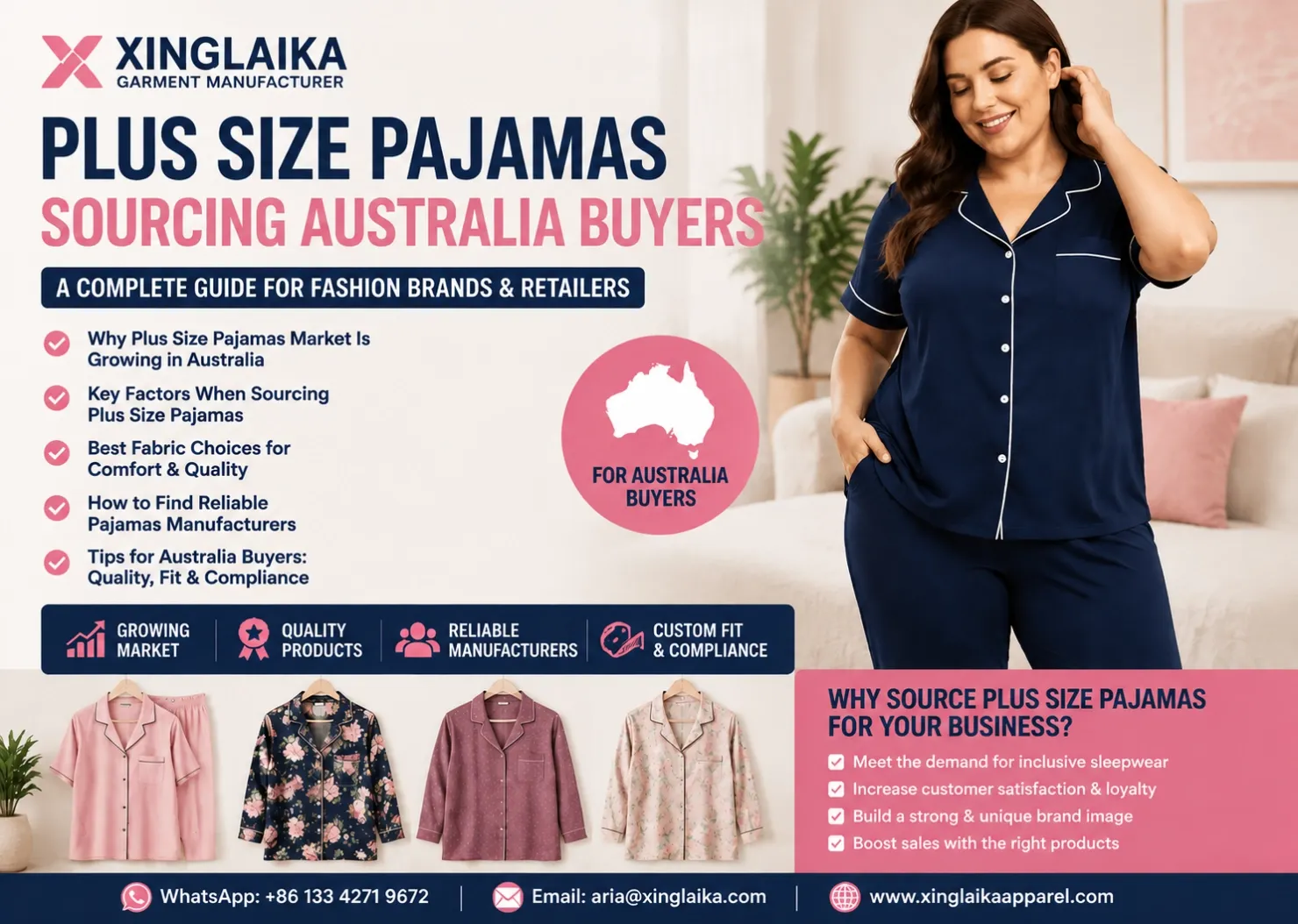
Plus size pajamas sourcing Australia is most reliable when a buyer turns a broad market opportunity into a controlled product brief, size strategy, and sample approval plan. For Australian fashion brands, boutiques, wholesalers, Amazon sellers, importers, distributors, and hotel or spa buyers, the practical 2026 task is not to chase a generic trend claim: it is to source sleepwear with clear fit, fabric, labelling, quality, and packing requirements for the intended channel.
This guide helps B2B buyers compare a plus size pajama manufacturer on the details that can be checked before a bulk order. It does not treat a site image, a broad factory statement, or an unverified compliance claim as proof for a particular programme.
Quick Answer for Buyers
- Define the customer, intended size range, base-size fit priorities, and sales channel before requesting prices.
- Give every supplier the same product brief, size chart, branding files, packing requirements, and target order quantity.
- Use samples to assess fit, drape, opacity, construction, labels, and presentation across the agreed size range.
- Ask suppliers to identify assumptions, sample dependencies, and order-specific approvals instead of accepting generic capability language.
- Start a focused discussion through Xinglaika Apparel's contact page with the current brief and launch window.
Turn the 2026 Trend Question Into a Buying Job
Search interest in plus size pajamas can lead buyers to vague requests such as "what is trending?" That is not sufficient for manufacturing. A buyer needs to decide which assortment can be specified, sampled, and packed for a defined customer and Australian sales channel. For example, a boutique might test a limited seasonal collection; a wholesaler may need a repeatable size and carton matrix; an Amazon seller may need variation planning, care information, and listing-ready packaging; a hotel or spa buyer may prioritise use, laundering, presentation, and replenishment planning.
Write the sourcing decision in one sentence: "Select a supplier that can develop the attached plus size woven pajama set to our size chart, brand files, and Australian channel packing requirements." This clarifies what a quotation must cover. It also prevents a factory comparison from becoming a price-only exercise.
Use the Xinglaika Apparel product collection to agree product vocabulary for collars, sleeves, waistbands, pockets, piping, prints, and set configurations. Product pages can support a design discussion, but they do not confirm availability, legal suitability, material performance, or customisation for a particular order. Confirm those matters in the project specification.
Build a Comparable Plus Size Pajamas Brief
The strongest sourcing trend is better definition: buyers who give precise inputs can compare responses more fairly. Mark each line as fixed, preferred, or open to supplier recommendation. Include the market and sales channel because they influence fit, labelling, packaging, and documentation questions.
Comparable brief checklist
- Customer and channel: Sets product, presentation, and fulfilment context Ask: Target customer, Australian sales channel, price position, and intended use
- Design reference: Defines the visible product Ask: Tech pack, sketches, photos, or marked reference images
- Size architecture: Makes fit review measurable Ask: Proposed size range, base size, measurements, grade rules, and fit priorities
- Fabric direction: Affects hand feel, drape, opacity, care, and cost Ask: Fibre preference, construction, weight target, finish, and applicable test needs
- Construction and trims: Avoids interpretation gaps Ask: Collar, placket, elastic, pockets, seams, closures, piping, and print placement
- Branding and labels: Controls artwork and product information Ask: Current logo, label copy, care information, barcode, and placement instructions
- Packaging: Defines the finished selling unit Ask: Folding, bag, insert, hanger, carton mark, and retailer or marketplace requirements
- Quantity and timing: Frames the production discussion Ask: Estimated quantity, sample deadline, launch window, and reorder outlook
Australian requirements can change by product, fibre content, labelling, packaging, sales channel, and destination. A buyer should state applicable requirements and obtain qualified legal, testing, customs, or marketplace advice where needed. Do not ask a manufacturer to substitute a broad claim for the buyer's own verification process.
Make Fit and Size-Range Review a Sample Gate
Plus size sourcing needs more than extending a label range. The buyer and supplier need one current measurement reference, an agreed base size, grading direction, tolerance expectations, and a way to consolidate comments. A reference image alone cannot establish fit, ease, rise, armhole shape, sleeve proportions, waistband behaviour, or garment length.
Ask how the sample will be reviewed against the agreed chart. Record which measurements are critical, who approves revisions, and how the final approved version is identified. Consider the intended fabric and construction: a woven set, knit set, nightdress, or robe may require different fit and recovery discussions. Where the buyer has an established fit block, share it. Where it does not, treat early sample review as a decision point rather than a formality.
The private label pajama brand guide offers a related brief-and-approval framework. Apply it to the actual size range instead of copying another brand's assumptions.
Compare Material, Construction, and Presentation Options
For an Australian buyer, material selection should connect commercial direction with actual product requirements. A soft hand feel, opacity, breathability, drape, durability, care expectations, print method, and retail price position can all influence the choice. State which factor is most important when the brief is still open. This gives a supplier a meaningful basis for offering alternatives.
Material and presentation checklist
- Fabric: Which options match the fibre, feel, weight, appearance, and care direction? Decision: Whether materials can be sampled against the intended product
- Construction: How will seams, elastic, pockets, plackets, piping, and closures be specified? Decision: Whether visible and fit-critical details are controllable
- Trims and print: What artwork, colour, placement, and approval files are required? Decision: Whether brand presentation can be reproduced consistently
- Labels and information: What copy, fibre, care, size, and market information must the buyer provide? Decision: Whether labels can be checked against the buyer's requirements
- Packing: What unit packing and carton marks does the channel require? Decision: Whether finished goods suit retail, marketplace, or wholesale handling
Approved real product and material media should be added during the next content refresh.
Evaluate Supplier Evidence Without Overclaiming
Useful supplier evidence is relevant to the present order, current, permissioned, and clear about scope. A gallery, a certificate image, a customer logo, or a statement about capacity does not by itself prove that the exact plus size program can be supplied. Ask questions that reveal how the supplier will work from the buyer's brief.
Supplier evidence checklist
- Development: Required inputs, sample sequence, and change-control method Decision: Whether the brief can become a usable specification
- Size control: Measurement record, grading inputs, and fit-comment process Decision: Whether fit approval remains traceable
- Materials: Options and sample dependencies tied to the stated direction Decision: Whether fabric choice can be tested
- Quality checks: Order-specific checks for appearance, stitching, measurements, labels, and packing Decision: Whether acceptance criteria can be documented
- Communication: Named point of contact and current-file management Decision: Whether revisions stay controlled
- Australian readiness: Buyer-specified labelling, documentation, testing, or channel questions Decision: Whether responsibilities are clear before commitment
The supplier's questions are evidence too. A strong response distinguishes confirmed information from items that need material selection, sampling, buyer approval, or external verification. Review how fashion brands source sleepwear from China for a complementary sourcing checklist, then request proof appropriate to your own order.
Manufacturing Process With Xinglaika Apparel
Xinglaika Apparel presents an OEM and ODM sleepwear workflow for global B2B buyers. For any Australian plus size pajamas order, confirm scope, responsibilities, and acceptance criteria in writing. This process description is not a promise of a particular material, test result, capacity, certification, or delivery date.
- Fabric selection. Align the fabric direction, hand feel, appearance, care needs, and feasible options. Record material information selected for the sample and the production specification.
- Pattern development. Develop or adjust the pattern from the approved brief, including the base size, measurements, grading inputs, waistband, neckline, sleeve, and construction details.
- Sample making. Review samples against the written size chart and expectations for fit, appearance, sewing, trims, print placement, labels, and measurements. Consolidate feedback into one revision record.
- Quality inspection. Agree order-relevant checks for material appearance, stitching, measurements, trims, labels, folding, and packing. The buyer should define applicable channel and market acceptance criteria.
- Bulk production. Start bulk work only after product, material, size, branding, label, and packaging approvals are aligned in a current specification.
- Packaging. Confirm folding, bags, inserts, barcode placement, carton marks, and buyer-specified market requirements before final packing.
The About Xinglaika Apparel page provides company context. Pair it with a project-specific sample plan and evidence request; do not infer order capability from general company information.
Control the Bulk-Order Handoff
Before bulk approval, create a single reference set containing the approved sample, current measurement chart, material and trim choices, artwork, labels, packing instructions, inspection criteria, and change log. The aim is not more paperwork. It is to make open decisions visible before they become costly production assumptions.
For an Amazon seller, also map the final product and pack configuration to the listing and fulfilment plan. For a boutique or wholesaler, confirm the size and colour ratio, assortment, and carton plan. For a hotel or spa buyer, record laundering, presentation, and replenishment assumptions. Each buyer should validate its own sales-channel obligations.
Request a Focused Australian Sourcing Discussion
For plus size pajamas sourcing Australia, send one current package: design reference, target customer, proposed size range and chart, quantity, fabric direction, branding files, target market, required documentation or testing questions, packaging, and launch window. This allows the supplier to identify what can be quoted, what needs sampling, and what needs buyer confirmation.
Contact Xinglaika Apparel to discuss a custom OEM or ODM sleepwear project. Include your design, target quantity, Australian sales channel, fabric preference, size range, labels, and packaging requirements so the conversation starts with a comparable brief.
FAQ
What should an Australian buyer send when requesting a plus size pajamas quote?
Send the design reference, target customer, intended channel, estimated quantity, size range and chart, fabric direction, construction details, branding files, packaging needs, and target launch window. State which requirements are fixed and which are open to recommendation.
How should buyers evaluate fit across a plus size range?
Agree a base size, measurement chart, grading inputs, fit priorities, and sample-review process. Review actual samples against the written brief, record comments in one version-controlled file, and approve changes before bulk work.
Can a supplier confirm Australian compliance for every order?
Do not rely on a generic confirmation. Applicable requirements depend on the product, fibre content, labels, packaging, sales channel, and destination. Define the relevant requirements and obtain qualified advice where necessary, then confirm order responsibilities in writing.
Which fabric questions matter most for plus size sleepwear?
Ask about the intended fibre, hand feel, weight, drape, opacity, care direction, print or trim compatibility, and the sample needed to evaluate them. Prioritise the factors that matter to the product and channel rather than choosing by a fabric name alone.
What quality checks should be agreed before a bulk order?
Agree order-specific checks for material appearance, stitching, measurements, trims, labels, folding, and packing. The buyer should define any channel or market acceptance criteria and keep them with the approved production specification.
When should private-label packaging be approved?
Approve labels, inserts, bags, barcode placement, folding, carton marks, and final artwork before bulk packing. Keep the approved version with the product specification so that branding and fulfilment instructions are traceable.
Request a Custom Quote
Looking for a plus size pajama manufacturer for the Australian market? Contact Xinglaika Apparel with your design, target quantity, target customer and channel, proposed size range and chart, fabric preference, applicable requirements, labels, and packaging requirements. Ask for a sample-led discussion that separates confirmed scope from items requiring buyer approval.