Aug 7, 2026Buying Guides
Custom Nightdress Manufacturer Guide for B2B Buyers
Choose a nightdress manufacturer with a clear brief, fabric plan, sampling, QC, labels, packaging, and a practical quote request for B2B buyers.
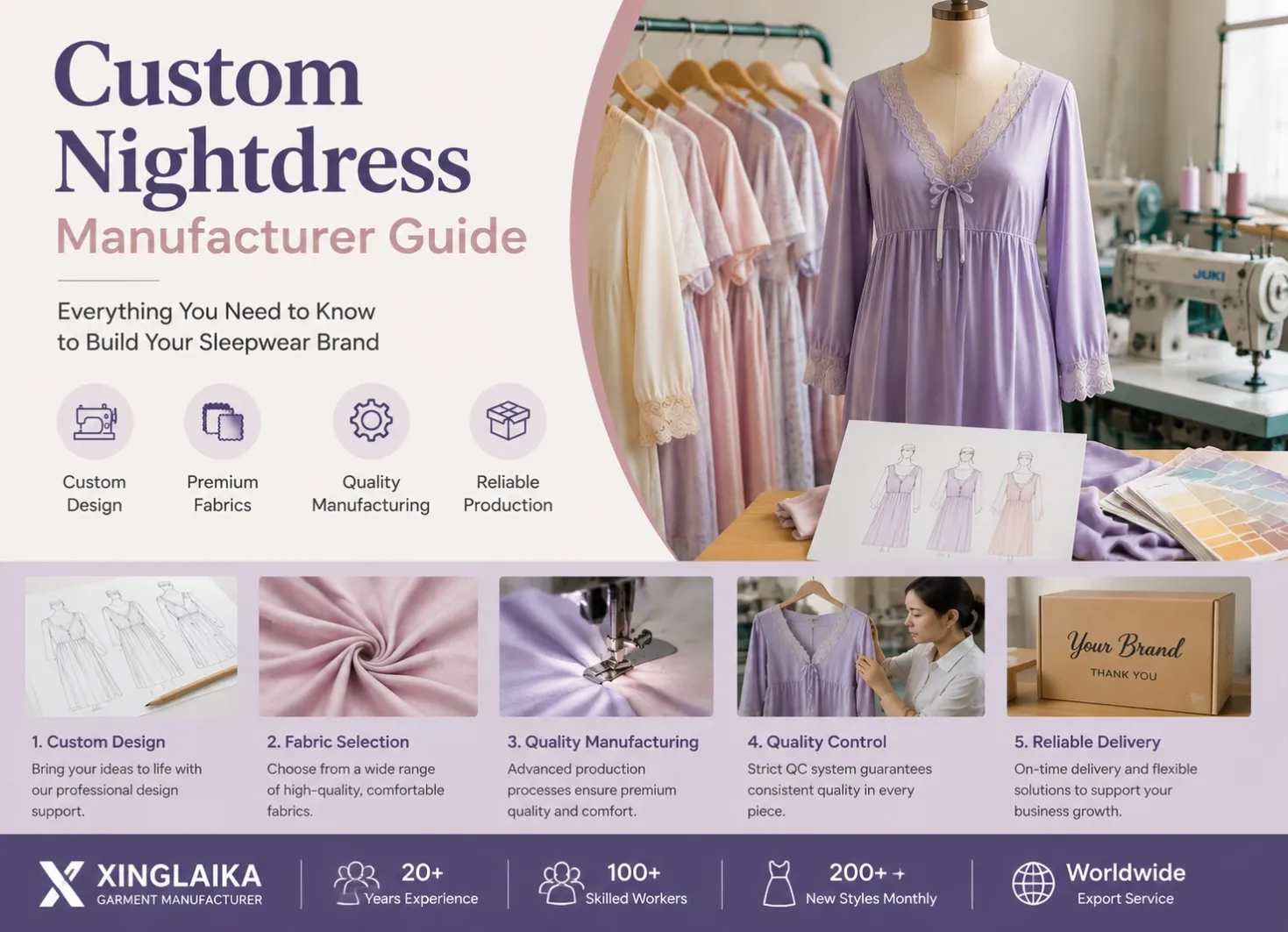
A suitable nightdress manufacturer helps a B2B buyer turn a defined collection brief into samples, production specifications, and a controlled bulk-order plan. For fashion brands, boutiques, wholesalers, Amazon sellers, importers, distributors, and hotel or spa buyers, the first decision is not simply which style looks best: it is whether the supplier can clarify fabric, construction, labeling, packaging, quality checks, and order communication before bulk production. This guide gives buyers a practical framework for evaluating a custom nightdress manufacturer and preparing a quote request.
Quick Answer for Buyers
- Start with a product brief that specifies the intended wearer, target market, price position, fabric preference, size range, and sales channel.
- Ask a nightdress manufacturer to separate what can be confirmed from what needs a sample, material approval, or order-specific quotation.
- Review a sample against written measurements, construction details, trim placement, labeling, and packaging requirements before approving bulk production.
- Compare suppliers on communication clarity and quality-control process, not on an unverified capacity, delivery, or certification claim.
- Use Xinglaika Apparel's contact page for a qualified inquiry after your brief is ready.
Define the Procurement Task Before Comparing Suppliers
The query "nightdress manufacturer" can cover several distinct buying jobs. A private-label brand may need a differentiated capsule collection. A wholesaler may need a repeatable core style with clear size and packaging requirements. A hotel or spa buyer may prioritize consistency, care instructions, and presentation. An Amazon seller needs to validate product labeling, variation planning, and packaging expectations for its target marketplace.
Before asking for a quote, document the decision you are trying to make. Is the project a new design, an adaptation of an existing reference, or a reorder? Are you buying a lightweight woven style, a knit style, a warmer brushed style, or a nightdress with decorative trims? Those choices affect material sourcing, pattern work, sample review, and the final commercial discussion.
Use the Xinglaika Apparel product collection to establish a product-language reference, then keep the supplier conversation focused on your actual product brief. An existing women's nightdress product example can help illustrate silhouette or finishing discussions, but it is not evidence that every fabric, decoration, or customization is available for every order.
Build a Supplier-Ready Nightdress Brief
A concise brief gives both sides a shared basis for sampling and quotation. It also reduces the risk of comparing two supplier responses that assume different materials or packaging.
Brief item | Why it matters | What the buyer should provide or ask |
|---|---|---|
Target customer and market | Influences style, sizing, labeling, and presentation | Intended market, wearer profile, and sales channel |
Design reference | Defines silhouette and visible details | Sketch, tech pack, photos, or marked reference images |
Fabric direction | Affects hand feel, drape, care, and cost | Fiber preference, weight range if known, and finish expectations |
Size range | Affects grading and measurement review | Base size, full range, fit priority, and tolerance expectations |
Branding | Determines label and trim decisions | Brand artwork, label copy, hangtag, and care-label requirements |
Packaging | Affects packing workflow and presentation | Folding method, bags, inserts, cartons, and barcode needs |
Commercial plan | Makes sampling and MOQ conversations usable | Estimated quantity, target launch window, and reorder potential |
Avoid asking a supplier to fill gaps with assumptions. If the fabric is undecided, say so and request feasible options with their trade-offs. If the quantity is provisional, give a realistic range. This is more useful than requesting a single universal price that cannot reflect the finished product specification.
What to Evaluate in a Nightdress Manufacturer
For B2B sourcing, the supplier's response should make the next decision easier. Buyers should look for precise questions, organized sample feedback, and a willingness to document what has and has not been approved. The table below is a practical comparison tool.
Evaluation area | Why it matters | Questions for the manufacturer |
|---|---|---|
Product development | Determines whether your reference can become a workable specification | What information is required before pattern development and sampling? |
Fabric and trims | Determines appearance, comfort, care, and repeatability | Which options can be quoted, sampled, and approved for this design? |
Fit and measurements | Protects against inconsistent sizing | How will measurements, grading, and sample comments be recorded? |
Quality inspection | Clarifies what will be checked before packing | What inspection points can be agreed for fabric, sewing, measurements, and packing? |
Branding execution | Keeps labels and packaging aligned with the brand brief | What artwork files and approval steps are needed for labels and packaging? |
Communication | Reduces handoff errors | Who consolidates questions, revisions, and approvals during sampling and production? |
Do not treat a polished product gallery as proof of a supplier's exact process. Ask for order-specific confirmation, and retain approved samples, measurement sheets, label artwork, and packaging specifications as part of the buying record. The About Xinglaika Apparel page is a useful starting point for company context; your final supplier decision should still be based on the documented scope of your own project.
Manufacturing Process With Xinglaika Apparel
Xinglaika Apparel presents an OEM and ODM sleepwear workflow for global B2B buyers. For each custom nightdress project, confirm the scope and approvals in writing rather than assuming every step or option applies automatically.
- Fabric selection. The buyer and supplier align on intended hand feel, appearance, care needs, and available material options. Approved fabric information should be carried into the sample and production specification.
- Pattern development. The pattern is developed or adjusted from the approved brief, including silhouette, size basis, and construction details. Buyers should identify any fit-critical points early.
- Sample making. A sample lets the buyer review fit, appearance, sewing, trims, and branding placement before bulk approval. Consolidate comments so revisions are traceable.
- Quality inspection. Agree the relevant inspection points for material appearance, stitching, measurements, trims, labels, and packing. A process statement is not a substitute for the buyer's own acceptance criteria.
- Bulk production. Begin bulk work after the product, measurements, materials, labels, and packaging have been approved for the order. Keep revisions controlled through one current specification.
- Packaging. Confirm folding, individual packaging, inserts, barcode placement, carton information, and any market-specific packaging needs before final packing.
Product, Material, and Customization Choices
Nightdress sourcing is easier when the buyer separates fixed decisions from options that need sampling. The silhouette may be fixed while the fabric, trim, print, color, or label remains open. That is normal, provided the decision path is explicit.
For a private-label launch, prioritize the product features that distinguish the line in your market, then request samples that test those features. For wholesale replenishment, prioritize repeatability and clear packing instructions. For hotel or spa programs, clarify the intended use, care expectations, and presentation requirements before agreeing a construction direction. Contact Xinglaika Apparel on WhatsApp or submit the contact form for a structured product conversation.
Why Choose Xinglaika Apparel
Xinglaika Apparel positions itself as a China OEM and ODM sleepwear and apparel manufacturer for global brands, boutiques, wholesalers, Amazon sellers, importers, and distributors. Its stated capabilities include 20+ years of experience, 100+ skilled workers, OEM and ODM service, flexible MOQ, custom labels, custom packaging, and worldwide export.
These points are useful screening topics, but a buyer should verify how they apply to the proposed nightdress, quantity, materials, target market, and timeline. Ask for the specific sample, production, quality-control, and packaging path for your order. Buyers that are also comparing China sourcing options can review how fashion brands source sleepwear from China before submitting a consolidated inquiry.
FAQ
What should I send to a nightdress manufacturer for an initial quote?
Send a sketch, tech pack, or marked reference images; your expected quantity range; target market; fabric direction; size range; label needs; and packaging requirements. State which items remain open so the supplier can identify the information needed for a reliable quotation.
Can a supplier quote before a sample is made?
Yes, a preliminary quotation may be possible from a sufficiently detailed brief. Treat it as conditional until fabric, construction, trims, branding, packaging, and quantity are confirmed. A sample helps test assumptions that a reference image cannot settle.
How should an Amazon seller evaluate a custom nightdress supplier?
Start with the product specification and marketplace requirements, then confirm how labels, packaging, variations, measurements, and approval records will be handled. Do not infer marketplace compliance or listing outcomes from a supplier's general product range.
What quality-control points matter for nightdress orders?
Common topics include fabric appearance, sewing, measurement consistency, trim attachment, print or color approval where applicable, labels, and packing. The relevant points should be written into the order-specific specification and reviewed against the approved sample.
Can I request custom labels and packaging?
Custom labels and packaging are listed as Xinglaika Apparel capabilities. Provide final artwork, copy, dimensions, materials, and packing instructions, then ask which approvals and lead-time dependencies apply to your order.
What should hotel and spa buyers clarify first?
Clarify the garment's intended use, size mix, fabric feel, care expectations, branding, packaging, and replenishment plan. These inputs help a manufacturer assess the appropriate product and production discussion without making unsupported assumptions.
Request a Custom Quote
Ready to evaluate a custom nightdress manufacturer for your next B2B collection or program? Contact Xinglaika Apparel with your design or reference images, target quantity, target market, fabric preference, size range, label artwork, and packaging requirements. Ask for the next sample and specification steps that apply to your project.