Aug 7, 2026Buying Guides
How to Compare Suppliers Before Ordering Custom Sleepwear
Compare a custom sleepwear supplier with one shared brief, sample checkpoints, quote scope, quality questions, and packing approvals before ordering.
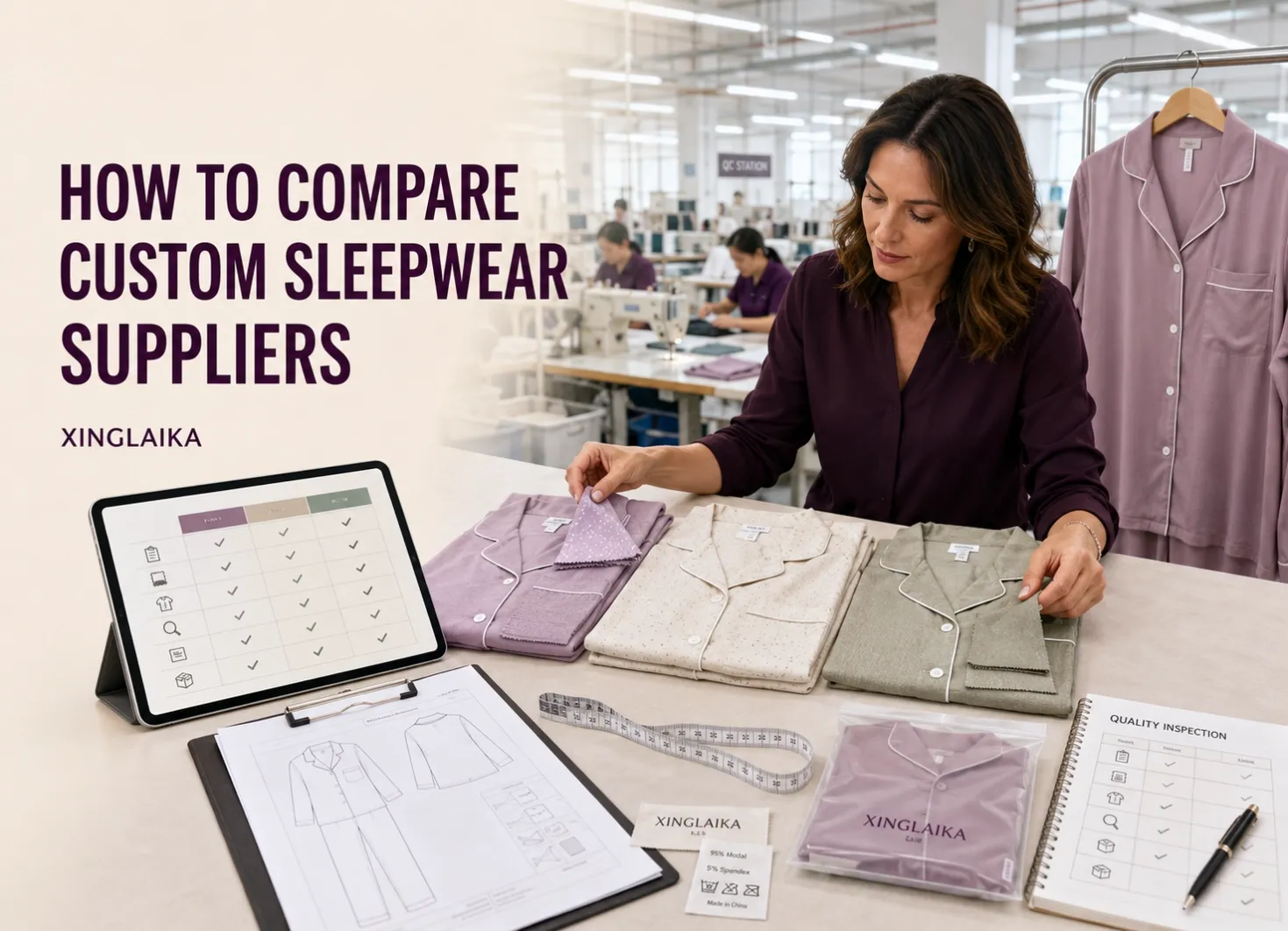
To compare a custom sleepwear supplier fairly, give every candidate the same dated product brief and evaluate the scope behind each answer, not the headline price alone. For fashion brands, boutiques, wholesalers, Amazon sellers, importers, distributors, and hotel or spa buyers, the decision is strongest when sample work, material choices, quality checks, and packing are made comparable before a bulk order is discussed.
This guide provides a procurement framework for choosing between custom pajama suppliers. It does not treat a website claim, a photo, a generic certificate statement, or an unverified customer reference as proof that a supplier can meet a particular programme.
Quick Answer for Buyers
- Send the same version-controlled brief, quantity range, target market, and launch window to each supplier.
- Compare what is included, excluded, assumed, or dependent on a sample; a low price is not comparable when the scope differs.
- Request a clear sample path for fabric, fit, construction, branding, labels, and packing before bulk approval.
- Define the buyer's acceptance criteria for the order and ask how each supplier records changes and quality findings.
- Start a focused supplier discussion through Xinglaika Apparel's contact page with the current brief attached.
Define the Decision Before Requesting Quotes
The first question is not simply, "Which supplier is cheapest?" It is, "Which supplier can develop and deliver this defined sleepwear programme with assumptions we can review?" A boutique test order, a wholesale size-and-colour assortment, an Amazon listing programme, and a hotel amenity or retail range can each require different sample, labelling, packing, and replenishment decisions.
Write the buying job in one sentence. For example: "Select a supplier to develop our attached woven pajama set to the stated size chart, brand files, target-market requirements, and retail-ready packing." This makes quotations easier to compare and gives suppliers a chance to identify missing inputs before they become production assumptions.
Use the Xinglaika Apparel product collection to align product vocabulary such as collar, sleeve, placket, piping, pocket, waistband, and set configuration. A product page can support a design discussion, but it does not confirm material availability, order-specific customization, market suitability, or commercial terms.
Send One Comparable Sleepwear Brief
Do not allow each supplier to quote from a different description. Issue one dated brief and note whether every point is fixed, preferred, or open to recommendation. Include any applicable buyer, channel, marketplace, legal, testing, customs, or labelling requirements; obtain qualified advice for requirements outside a supplier's confirmed scope.
Brief item | Why it matters | What the buyer should provide or ask |
|---|---|---|
Product reference | Defines the intended style | Tech pack, sketches, marked photos, and construction priorities |
Customer and channel | Frames product presentation and handling | Target customer, sales channel, price position, and intended use |
Size and fit | Makes sample feedback measurable | Size range, base size, measurement chart, and fit priorities |
Fabric and trims | Controls appearance, hand feel, care, and cost | Fibre direction, construction, weight, finish, colours, and trim details |
Branding | Prevents artwork ambiguity | Logo files, label copy, care information, barcode, and placement |
Packing | Defines the finished selling unit | Folding, bags, inserts, hangers, carton marks, and channel needs |
Quantity and timing | Provides commercial context | Estimate, sample target, launch window, and reorder outlook |
Compare Quote Scope, Not Just Unit Price
Ask each custom sleepwear supplier to identify the basis of its response. A unit price may depend on a fabric substitute, simplified construction, different size range, unpriced branding element, different packing method, or an assumption about order volume. Comparing prices without those conditions can move risk from the quotation stage to the sample or bulk stage.
Comparison point | Buyer question | Evidence to request or confirm |
|---|---|---|
Product interpretation | Which design details are included or still open? | Written scope, marked reference, and questions list |
Material basis | Which fabric and trims support the price? | Material description, available options, and sample plan |
Sample path | What is reviewed before bulk work? | Sample stages, feedback method, and revision record |
Size control | How are measurements and fit handled? | Base-size plan, chart, tolerances where agreed, and fit comments |
Branding and packing | Which items are included in the quote? | Artwork checklist, label placement, unit packing, and carton notes |
Quality discussion | What order-specific checks can be aligned? | Proposed checkpoints and buyer acceptance criteria |
The quality of a supplier's questions is useful information. A careful response makes assumptions visible, distinguishes a proposal from a confirmed specification, and tells the buyer where a sample or third-party input is needed.
Evaluate the Sample and Change-Control Process
A sample is a decision tool, not merely a photo opportunity. Before requesting one, agree what it must demonstrate: silhouette, fit, fabric hand feel, opacity, drape, stitching, trims, print or embroidery position, label copy, and packing presentation. Consolidate feedback in one dated file so the supplier receives a clear instruction set.
Ask who receives comments, how revisions are recorded, which version is current, and what approval is needed before bulk work. This matters especially when several people approve design, sourcing, quality, and packaging. It reduces the risk that the bulk order follows an old reference or verbal preference.
Assess Manufacturing Process for the Actual Order
Xinglaika Apparel presents an OEM and ODM sleepwear workflow for B2B buyers. Treat the following process as a discussion framework and confirm its applicability, responsibilities, timing, and acceptance criteria for the actual order.
- Fabric selection. Align the fabric direction, appearance, hand feel, care expectations, and feasible material options against the brief.
- Pattern development. Develop or adjust the pattern from the approved reference, including fit-critical points such as the base size, neckline, sleeve, waistband, and construction.
- Sample making. Review the sample against the written brief for fit, measurements, sewing, trims, print placement, labels, and presentation.
- Quality inspection. Agree order-relevant checks for material appearance, stitching, measurements, trims, labels, folding, and packing; define buyer acceptance criteria.
- Bulk production. Start bulk work only after product, material, size, branding, and packaging approvals are aligned in one current specification.
- Packaging. Confirm folding, bags, inserts, barcode placement, carton markings, and buyer-specified channel requirements before final packing.
Ask for Verifiable Supplier Evidence
When comparing suppliers, request project-relevant and permissioned evidence rather than broad promises. Suitable questions can include whether a similar product reference is available for review, what sample and material options can be assessed, how the supplier tracks changes, and which quality checkpoints can be agreed for the order. Do not assume that a general factory description confirms capacity, certification, customer history, shipping terms, or delivery performance for your project.
The About Xinglaika Apparel page provides company context. Use it as a starting point, then request order-specific responses. If a supplier describes years of experience, workforce, flexible MOQ, export markets, OEM or ODM service, custom labels, or custom packaging, ask how that statement applies to your design, quantity, target market, and timetable before relying on it.
Why Choose Xinglaika Apparel
Include Xinglaika Apparel in a controlled comparison when its product direction and service discussion fit your brief. Use the company context page, product collection, and project conversation to test the factors that matter to your order: OEM or ODM scope, sample path, material options, quantity discussion, custom labels, custom packaging, quality checkpoints, and export or destination requirements.
The comparison should remain evidence-led. Request project-specific clarification for any statement about experience, workforce, MOQ, capacity, certifications, customers, delivery, or market coverage. A supplier should be selected because the written scope, sample outcome, communication, and commercial fit meet the actual brief, not because a general statement sounds persuasive.
Score Suppliers With a Consistent Matrix
Use a weighted score only after the same questions have been asked. Score response clarity and project fit, not marketing language. Keep short notes explaining each score; this helps a buying team defend the decision and identify what must be clarified before placing an order.
Evaluation area | What good looks like | Red flag to investigate |
|---|---|---|
Brief understanding | Supplier restates key requirements and asks useful questions | Quote ignores material, size, or packing details |
Sample control | Clear review points and documented changes | Approval path remains verbal or undefined |
Quote transparency | Scope and assumptions are visible | Price has no material, branding, or packing basis |
Quality planning | Buyer criteria can be discussed in practical terms | Generic assurance replaces order-specific checkpoints |
Communication | One current file and clear next actions | Conflicting versions or unanswered assumptions |
Commercial fit | Quantity, timing, and service scope are discussed | Broad promises without project confirmation |
Plan Labels, Packing, and Channel Handoffs
For private-label sleepwear, label and packing choices should be part of the comparison, not an afterthought. Discuss logo files, brand labels, care content, hangtags, barcodes, folding, bags, inserts, assortment ratios, carton markings, and the required approval point. An Amazon seller may also map the final product and pack configuration to listing and fulfilment needs. A wholesaler may prioritize size, colour, and carton matrices. A hotel or spa buyer may prioritize use, laundering, presentation, and replenishment planning.
Contact Xinglaika Apparel on WhatsApp or submit the contact form for a structured product conversation. For service choices, read OEM vs ODM Sleepwear Manufacturing Explained. For brand-launch planning, read How to Start a Private Label Pajama Brand. These pages support the brief; they do not replace a sample or order-specific confirmation.
Choose a Supplier and Record Open Items
Before choosing, record the selected supplier, the comparison basis, remaining assumptions, sample approvals needed, and the owner for each open point. The decision may be to proceed with a sample, request a revised quotation, or pause until the brief is complete. That is a stronger procurement outcome than selecting a supplier on price before the order is defined.
Keep the approved sample, measurement chart, fabric and trim decisions, artwork, labels, packing instructions, inspection criteria, and change log together. The current file set should be the reference for everyone involved in the handoff to bulk work.
FAQ
What should I send to a custom sleepwear supplier for a comparable quote?
Send the same dated brief to each supplier: design references or tech pack, quantity, target market and channel, fabric direction, size range and chart, construction details, brand files, packing needs, and target launch window. State what is fixed and what needs options.
How many custom sleepwear suppliers should I compare?
There is no universal number. Compare enough suppliers to test the market while keeping the brief and follow-up manageable. The comparison is meaningful only when every candidate receives the same inputs and is evaluated on the same criteria.
What matters more than the lowest sleepwear quote?
Compare the scope behind the quote: materials, construction, size range, sample work, labels, packing, quality checkpoints, assumptions, and change-control process. A lower quote may not cover the same programme.
How can I verify a supplier's claimed capability?
Ask for project-relevant, permissioned information and confirm how it applies to the order. Use samples, written specifications, and agreed checkpoints. Do not treat generic capability, certification, customer, or delivery statements as universal proof.
When should labels and packaging be confirmed?
Bring labels and packing into the initial brief, then finalize their copy, placement, materials, and approval points before bulk work. They affect the finished selling unit and may affect the quote and timing.
Can a product page confirm that a supplier can make my sleepwear design?
No. Product pages help establish style vocabulary and discuss comparable products, but material, construction, quantity, sample scope, customization, commercial terms, and buyer requirements must be confirmed for the actual programme.
Request a Comparable Custom Sleepwear Quote
Looking for a custom sleepwear supplier for an OEM, ODM, private-label, wholesale, marketplace, or hospitality programme? Contact Xinglaika Apparel with your design or references, target quantity, target market, fabric direction, size range, label requirements, packaging requirements, and launch window. Identify the points that need sample options or confirmation so the response can be compared on a clear basis.