Aug 7, 2026Buying Guides
How to Start a Private Label Pajama Brand: A B2B Sourcing Guide
Learn how B2B buyers can launch private label pajamas with the right product brief, samples, supplier questions, QC plan, labels, and packaging.
Match the Search Intent to the Buyer Task
The primary query, private label pajamas, can attract both early-stage brand research and buyers ready to source. This page is built for the commercial and transactional part of that demand: a buyer who needs to decide what to send a private label pajama manufacturer, how to compare supplier responses, and what must be approved before a bulk order.
Search intent | Appropriate next step | What this guide provides |
|---|---|---|
Brand-launch research | Define the first range and market position | A focused product-brief checklist |
Supplier evaluation | Compare order-specific feasibility | Questions for materials, minimums, samples, and QC |
Quote-ready sourcing | Send a qualified inquiry | Required design, quantity, market, label, and packaging inputs |
The article intentionally does not target consumer searches for single-pair retail pajamas, DIY sewing patterns, free designs, jobs, repairs, or used products. Those searches do not match a B2B sleepwear manufacturing inquiry.To start a private label pajama brand, define a focused product range, turn it into a supplier-ready brief, approve samples, and set quality and packaging requirements before a bulk order. For fashion brands, boutiques, wholesalers, Amazon sellers, importers, distributors, and hotel or spa buyers, the key decision is whether a supplier can translate that brief into repeatable, order-specific production. This guide shows what to prepare and what to verify when sourcing private label pajamas.
Quick Answer for Buyers
- Start with one customer, one price position, and a small range of related pajama styles instead of a broad catalog.
- Send suppliers a brief covering product references, fabric, measurements, colors, branding, packaging, quantity, target market, and requested delivery window.
- Treat a sample as an approval gate, not a display item. Record fit, construction, color, labeling, and packaging changes in writing.
- Compare quotations on the same configuration. A low unit price is not comparable if fabric, trims, packaging, defect handling, or freight terms differ.
- Release bulk production only after the approved sample and inspection criteria match the purchase order.
Define the Private Label Pajama Offer Before Contacting Suppliers
Private label pajamas are branded sleepwear sold under the buyer's name, while manufacturing and product development may be handled by an external supplier. A launch can use a buyer's original design, adapt a supplier base style, or combine both. The practical question is not simply who can make pajamas; it is what degree of customization is needed for the first order.
Choose a buyer and use case first. A boutique may need a tight seasonal capsule with coordinated colors. A wholesaler may need dependable repeat styles and clear size runs. An Amazon seller may need packaging, labeling, and product information that fit the listing and fulfillment plan. A hotel or spa buyer may prioritize robe or pajama consistency across locations. These are different briefs, even when the product category is the same.
Write a one-page range definition before you request a quote:
Brief item | Why it matters | Buyer decision |
|---|---|---|
Customer and price position | Guides fabric, construction, and packaging choices | What level of product is being launched? |
Style list | Keeps the initial range focused | Which sets, separates, robes, or nightwear pieces are essential? |
Fabric and season | Changes feel, cost, care, and suitability | What material performance is required? |
Size range | Affects grading and sample approval | Which market's fit expectations apply? |
Brand assets | Defines labels, hangtags, and packaging | What must carry the brand identity? |
Quantity by style and color | Lets suppliers assess order-specific minimums | What is the realistic first order? |
Do not present a website product image as a final specification. Use it as a reference, then confirm current fabric availability, customization scope, and order requirements with the supplier.
Build a Supplier-Ready Product Brief
A clear product brief reduces sampling loops and makes supplier quotes more comparable. For every style, attach a sketch, reference image, or annotated product photo. Identify the silhouette, target fabric or acceptable alternatives, color references, measurements, seam or trim preferences, care label content, logo placement, packaging, and expected quantity.
For example, buyers can review Xinglaika Apparel's Products page for range discussion, including the short-sleeve pajama set TE-160 and the plus-size printed pajama set AL-020. These are starting points, not evidence that an exact fabric, color, or customization option is available for a new order.
Ask each prospective private label pajama manufacturer to respond to the same questions:
- Which parts of this brief are feasible for the stated quantity?
- What is the sample sequence, approval point, and revision process?
- Which materials, trims, labels, and packaging components require buyer confirmation?
- What information must be finalized before bulk production can begin?
- What inspection points and defect-resolution process apply to this order?
This is more useful than asking for a generic price list because it exposes assumptions before they become late changes.
Evaluate Supplier Fit with a Launch Decision Matrix
The right supplier is one whose process fits the launch, not necessarily one making the broadest claims. Use the matrix below for an order-specific comparison.
Factor | What to verify | Risk if unclear |
|---|---|---|
Product development | Whether the supplier can work from your design or a base style | Unplanned redesign and sample delays |
Fabric selection | Composition, hand feel, color approval, care needs, and substitutions | Product differs from the intended position |
Minimum order | Minimums by style, color, fabric, and trim configuration | Quote cannot support the planned assortment |
Brand components | Label artwork, hangtag, polybag, carton marks, and packaging approvals | Branding arrives late or differs from the brief |
Quality control | Measurements, workmanship, color, packing, and defect process | Disputes without an agreed acceptance standard |
Communication | Named approval steps and written change records | Scope changes are lost between sample and bulk |
Review the supplier's company information on the About Us page, then ask for evidence relevant to your own product. A website overview cannot replace an order-specific discussion of material, timing, quality criteria, and applicable minimums.
Manufacturing Process with Xinglaika Apparel
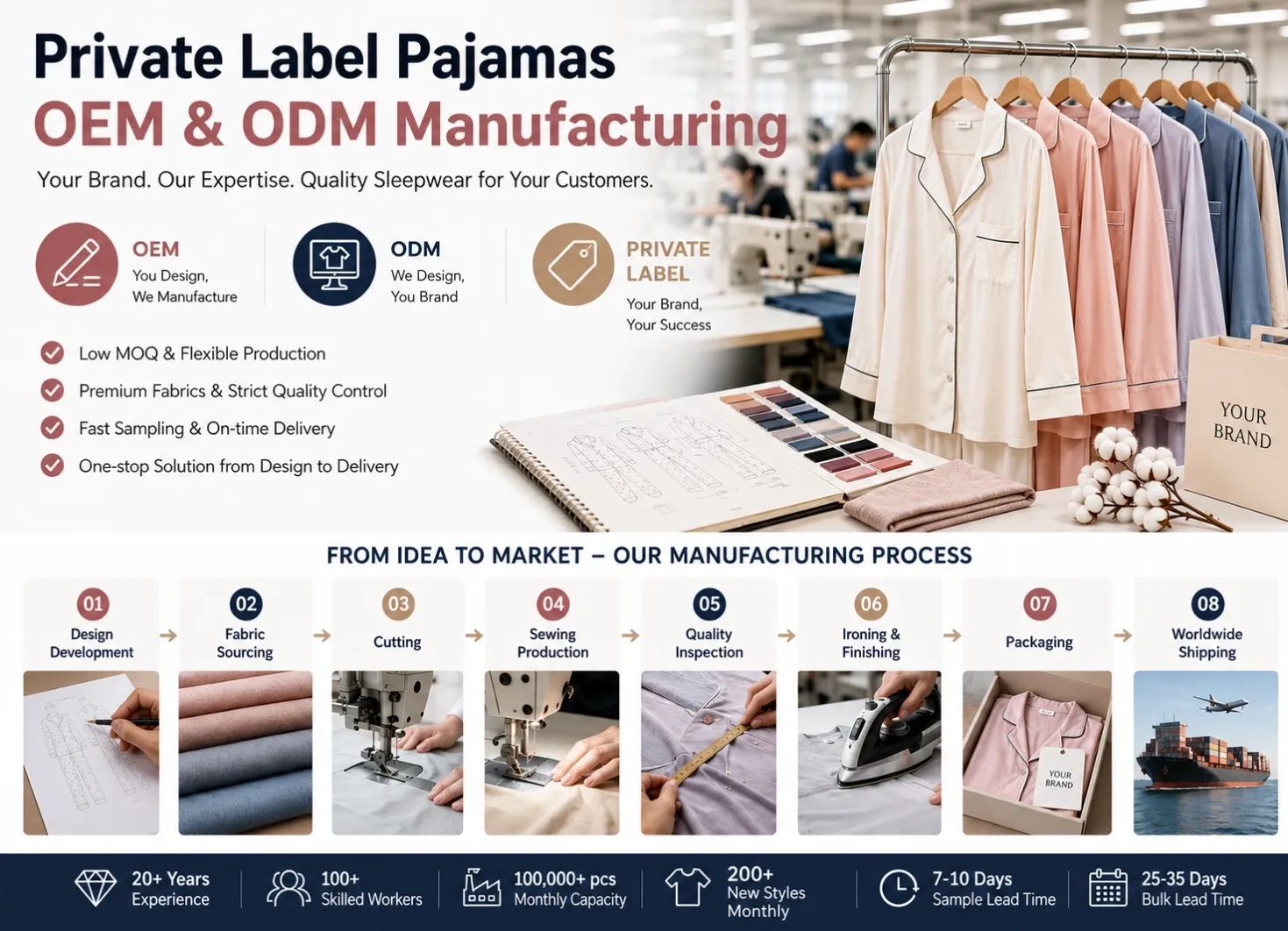
For a private label pajama project, the manufacturing process should turn the approved brief into traceable production decisions. Confirm the steps and approvals for your order with Xinglaika Apparel rather than assuming every option applies.
- Fabric selection: Review the desired composition, weight, hand feel, color, care requirements, and acceptable alternatives. Keep the selected material in the approved record.
- Pattern development: Translate the chosen style and size range into measurements and construction details. Flag market-specific fit requirements before sampling.
- Sample making: Make and review a sample against the brief. Record amendments to fit, fabric, trims, artwork, labels, and packaging.
- Quality inspection: Define the measurable checks for workmanship, measurements, color, accessories, packing, and any buyer-specified inspection standard.
- Bulk production: Start only after the approved sample, purchase order, and required approvals align. Manage changes in writing so the approved version remains clear.
- Packaging: Confirm folding, labels, hangtags, polybags, cartons, carton marks, and destination requirements before final packing.
Approve Samples and Quality Criteria Before the Bulk Order
Sampling is where a private label pajama brand turns an idea into a controlled specification. Inspect the sample against a written checklist rather than relying on a general visual impression. Check the size chart, key garment measurements, seam finishing, print or embroidery placement, color, fabric feel, label content, care instructions, packing, and any destination-specific requirements.
Make an approval file with dated photos, comments, and the final agreed version. If a change affects cost, timing, or configuration, ask for the revised quotation or confirmation before bulk production. This protects both buyer and supplier from a mismatch between an early sample and the final order.
Plan Labels, Packaging, and the Route to Market
Branding components can be simple, but they still need a decision owner and lead-time check. Specify the main label, size label, care label, hangtag, barcode or SKU requirements, polybag, inserts, carton marks, and any retail-ready packaging. Amazon sellers should also make their fulfillment and labeling requirements explicit. Importers and distributors should align carton information and destination documentation with their own downstream process.
Contact Xinglaika Apparel on WhatsApp or submit the contact form for an initial product conversation, then set the final brand and packaging configuration in the supplier brief. The buyer should own the accuracy of brand artwork and market-facing information; the supplier should confirm what it can manufacture and pack for the order.
Why Choose Xinglaika Apparel
Xinglaika Apparel presents itself as a China OEM and ODM sleepwear and apparel manufacturer for global brands, boutiques, wholesalers, Amazon sellers, importers, and distributors. Its stated capabilities include 20+ years of experience, 100+ skilled workers, OEM and ODM service, flexible MOQ, custom labels, custom packaging, and worldwide export. Buyers should validate the applicability of these capabilities, material options, minimums, and lead-time assumptions against their own design and order before committing.
For an initial conversation, use the Xinglaika Apparel home page to orient the range and then contact the team with a documented brief. That makes it easier to determine whether an OEM, ODM, or adapted base-style approach is appropriate for the launch.
FAQ
What is the minimum order for private label pajamas?
Minimums depend on the style, fabric, color, trim, branding components, and production configuration. Give the supplier quantities by style and color, then request the minimum that applies to that exact configuration.
Should a new brand start with OEM or ODM pajamas?
Choose OEM when you have a defined design and specification. Choose ODM or a base-style adaptation when speed and lower development complexity matter more than creating every element from scratch. Ask what can be customized at your target quantity.
What should I send with a private label pajama inquiry?
Send reference images or a tech pack, target quantity by style and color, fabric preference, size range, target market, label artwork, packaging requirements, requested delivery window, and any product or compliance requirements you already know.
How many samples should I approve before bulk production?
The number depends on how new or complex the product is. At minimum, use a documented approval process for the sample that represents the final construction, materials, branding, and packaging decisions. Confirm any revisions in writing.
Can a supplier use a website pajama style as a starting point?
Often a website style can start a discussion, but it is not a final production specification. Confirm current availability, fabric options, measurements, customization scope, minimums, and sample requirements for the proposed order.
What quality checks should be included for private label sleepwear?
Agree on measurable checks for fabric, color, sizing, construction, trims, labels, packing, and defects. Add any market or buyer-specific requirements to the written order documents before bulk production begins.
Request a Custom Quote
Ready to launch private label pajamas? Contact Xinglaika Apparel with your design or reference style, target quantity by style and color, target market, fabric preference, size range, label artwork, packaging requirements, and requested delivery window. Ask the team to confirm the appropriate OEM, ODM, or adapted base-style path, sample steps, order-specific minimums, and quality checkpoints before you place a bulk order.