Jul 25, 2026Buying Guides
OEM vs ODM Sleepwear Manufacturing Explained for B2B Buyers
Compare OEM and ODM sleepwear manufacturing for brands, wholesalers, and private-label buyers. See control, sampling, MOQ, QC, and supplier questions.
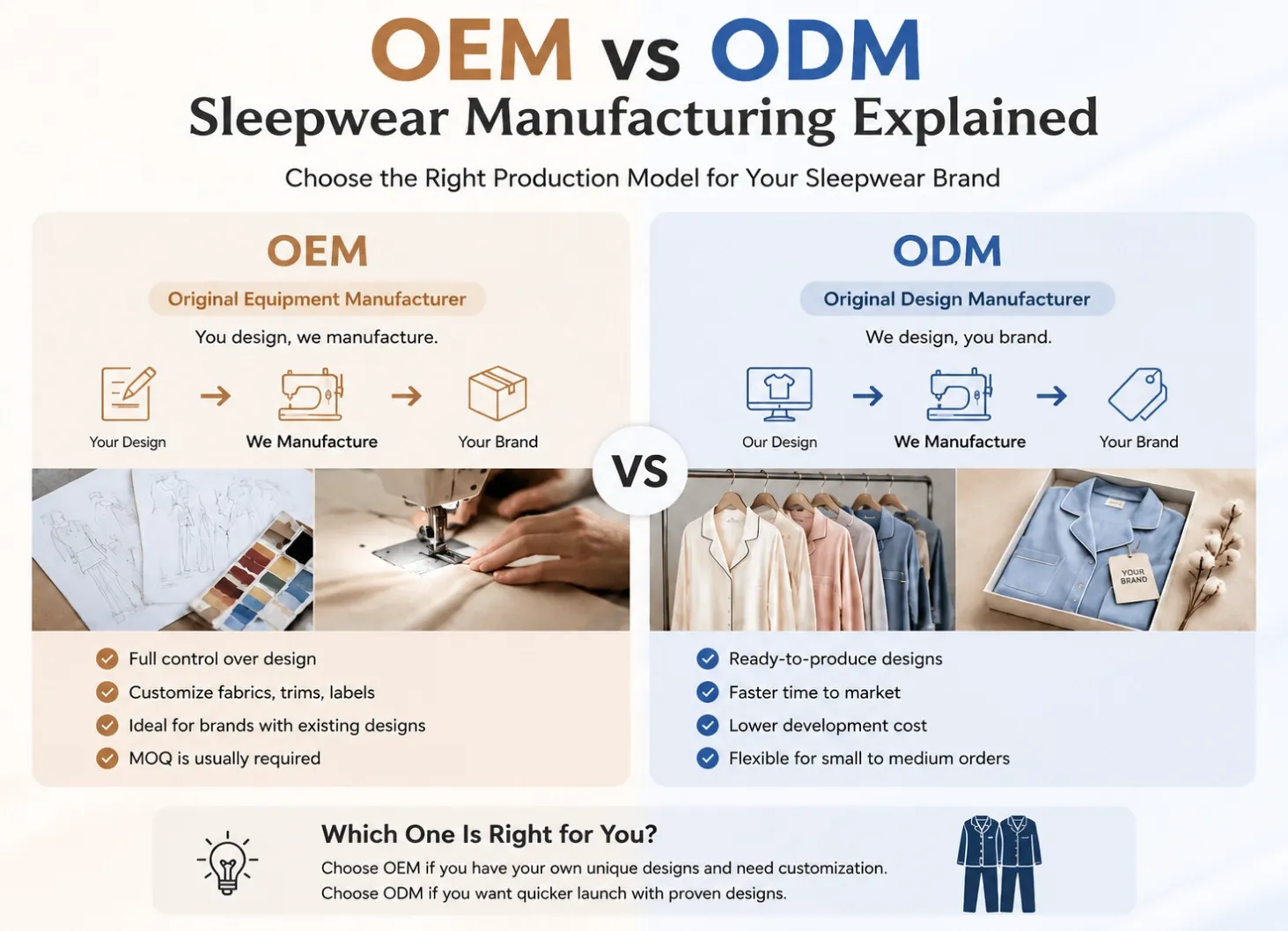
For a brand or wholesale buyer, the choice between an OEM sleepwear manufacturer and an ODM sleepwear manufacturer decides how much design control, development time, and product risk you carry. Choose OEM when you need a supplier to make a sleepwear design to your specification; choose ODM when you want to start from an existing supplier style and customize the commercial details. This guide helps fashion brands, boutiques, Amazon sellers, importers, distributors, and hotel or spa buyers turn that choice into a clear supplier brief.
Quick Answer for Buyers
If your priority is | Usually choose | Why |
|---|---|---|
A distinctive fit, print, or construction | OEM | Your team controls the technical brief and approval points. |
A faster entry with an existing base style | ODM | The supplier begins with a developed style rather than a blank page. |
Building a long-term private-label range | OEM or staged ODM | Start with a proven ODM base, then move key bestsellers to OEM. |
Testing a small market or seasonal capsule | ODM | Fewer development decisions can shorten the early planning stage. |
Protecting a design direction | OEM | Clarify ownership, confidentiality, and approved use in writing before sampling. |
An OEM sleepwear manufacturer is not automatically the better commercial choice. It requires a usable brief, timely approvals, and agreement on fabric, grading, packaging, and quality standards. ODM can be a practical path when your buyer team needs a manufacturable starting point, but it still needs a documented scope so an existing style does not become an ambiguous custom project.
What OEM and ODM Mean in Sleepwear Sourcing
OEM (original equipment manufacturing) means the buyer brings the product direction. That may be a full tech pack, graded patterns, reference samples, an original print file, or a structured brief that defines what the supplier must develop. In sleepwear, OEM commonly covers silhouettes, fabric weight and composition targets, trims, size charts, labels, care labels, packaging, and inspection requirements.
ODM (original design manufacturing) means the supplier starts from an existing product concept or developed style. The buyer selects it and may adapt colors, prints, labels, packing, or other commercially agreed details. The exact degree of customization varies by supplier and by the starting style, so ask which parts are fixed and which parts can change before you quote a launch price.
For product references, buyers can review Xinglaika Apparel's Products page (https://www.xinglaikaapparel.com/products), including the short-sleeve pajama set TE-160 (https://www.xinglaikaapparel.com/products/short-sleeve-pajama-set-te-160) and the plus-size printed pajama set AL-020 (https://www.xinglaikaapparel.com/products/plus-size-short-sleeve-printed-pajama-set-al-020). Treat website examples as starting points for discussion; confirm current availability, fabric options, and customization scope with the supplier.
The Buyer Decision: Control, Speed, and Development Risk
The decision is best made before requesting quotations. A buyer who asks for an OEM price without settling the key specifications will receive quotes that are difficult to compare. A buyer who calls a project ODM while requesting a new silhouette, custom construction, and multiple fit rounds may create the same ambiguity in reverse.
Buying factor | OEM route | ODM route | What to ask the supplier |
|---|---|---|---|
Design input | Buyer-led specification | Supplier-developed base style | What files or references are required to begin? |
Development time | Depends on brief quality and sample revisions | May be shorter when the base style is suitable | Which dates are estimates and which are confirmed after approval? |
Fabric | Buyer selects or approves the target | Existing option may be offered first | What composition, weight, hand feel, and color approvals apply? |
MOQ | Depends on materials, colorways, and production setup | May be more flexible for existing materials | Is MOQ per style, color, size run, or total order? |
Branding | Custom labels and packaging can be specified | Often added to an existing style | Which label, carton, barcode, and insert details are included? |
Quality control | Buyer can define checkpoints and tolerances | Buyer still needs written acceptance criteria | What is inspected, when, and how are defects handled? |
For OEM, prepare a product brief that separates must-have details from preferences. A useful brief includes target customer, intended retail position, reference images, fabric targets, construction details, size range, print files, label artwork, packaging, desired quantity, target market, and required delivery window. Request clarification rather than assuming that a reference photo communicates seam placement, fabric performance, or grading rules.
For ODM, ask for the style code, current base fabric, available colors, size range, modification limits, available brand components, sample cost, applicable MOQ, and replenishment assumptions. This list turns an attractive sample into a comparable commercial offer.
A Practical Sourcing Checklist Before You Request Samples
Use the same checklist for every shortlisted OEM sleepwear manufacturer or ODM supplier. It reduces the risk of comparing a low-scope quotation with a fully specified one.
- Define whether you are buying a custom design, an adapted existing style, or a hybrid.
- State the proposed order quantity by style, color, and size range.
- Specify the target market so labeling, sizing, and packaging questions can be identified early.
- Describe fabric priorities, including composition, weight, opacity, softness, stretch, shrinkage expectations, and color requirements.
- Provide logo files and identify every branding point: neck label, care label, hangtag, polybag, carton, and inserts.
- Agree sample milestones, approval owners, revision limits, and the date from which bulk lead time starts.
- Write acceptance criteria for workmanship, measurement tolerance, fabric appearance, packing, and pre-shipment inspection.
- Ask what information must be verified by you, such as current capability, material availability, compliance needs, and shipping terms.
This process is especially important for Amazon sellers and importers. A product that appears straightforward can still fail commercially if its packaging, barcode handling, labeling, carton configuration, or size presentation does not match the launch channel.
Manufacturing Process With Xinglaika Apparel
For any project, ask Xinglaika Apparel to confirm the actual sequence, responsibility, and approval date for your order. The following buyer-facing process is a planning framework, not a claim that every project follows identical timings.
- Fabric selection. The buyer and supplier align on composition, color, hand feel, weight, performance requirements, and material availability. Retain swatches or an approved standard where practical.
- Pattern development. For OEM work, the pattern is developed or adjusted from the buyer's brief. For ODM, the supplier confirms the base pattern and which changes are feasible. Agree the size range and measurement points before sampling.
- Sample making. The sample tests the agreed product direction. Record comments in one consolidated approval round so changes are traceable.
- Quality inspection. Define measurement, workmanship, fabric, labeling, and packing checks before bulk production. Clarify who reviews each checkpoint and what happens when a nonconformance is found.
- Bulk production. Bulk work should begin from an approved sample and documented specifications, not from informal chat changes. Confirm production updates and any material substitutions in writing.
- Packaging. Review labels, folding, polybags, inserts, cartons, marks, and shipping documentation against the target market and channel requirements.
Product and Customization Options to Clarify
An OEM project may include custom fabrication, a new print, adjusted fit, labels, and packaging. An ODM project may include only selected colorways and private-label elements, or it may allow broader adaptation. Neither description alone tells you the commercial scope.
Ask the supplier to break the quotation into product, development, and packaging components. This creates a useful decision record when comparing alternatives. You can also use Xinglaika Apparel's catalog download (https://www.xinglaikaapparel.com/catalog-download) to request an initial range review, then use the About Us page (https://www.xinglaikaapparel.com/about-us) and direct supplier conversation to verify the capabilities relevant to your order.
Common options to clarify include:
- Fabric source and approved substitute rules.
- Print method, repeat scale, and color approval process.
- Buttons, piping, elastic, embroidery, or other trims.
- Size grading, plus-size requirements, and measurement tolerances.
- Woven labels, printed care labels, hangtags, barcode labels, and carton marks.
- Individual packing, gift packaging, and bulk shipment configuration.
Why Choose Xinglaika Apparel
Xinglaika Apparel presents itself as a China OEM and ODM sleepwear and apparel manufacturer serving global brands, boutiques, wholesalers, Amazon sellers, importers, and distributors. Its stated service points include 20+ years of experience, 100+ skilled workers, OEM and ODM service, flexible MOQ, custom labels, custom packaging, and worldwide export.
Those points should be treated as supplier statements to verify for the specific program, not as a substitute for due diligence. Ask for the evidence that matters to your order: relevant product examples, current production capability, sample quality, minimums by product configuration, lead-time assumptions, and the process for managing defects or changes. That is a more reliable basis for selecting an OEM sleepwear manufacturer than a generic capability list.
FAQ
Is OEM or ODM better for a new sleepwear brand?
ODM may be a practical way to validate a range using an existing base style, while OEM is better suited to a differentiated product direction. The right choice depends on your design readiness, launch schedule, target quantity, and need for exclusive details.
Can an ODM sleepwear style use my own label and packaging?
Often it can, but the available options, minimums, artwork requirements, and costs must be confirmed per style. Request a written list of included branding elements and any separate setup charges.
What should I send to an OEM sleepwear manufacturer for a quotation?
Send reference images or a tech pack, intended quantity by style and color, target market, fabric preferences, size range, branding files, packaging requirements, and a realistic requested delivery window. The more precise the input, the more comparable the quotation.
Does OEM always require a higher MOQ than ODM?
Not always. MOQ depends on fabric, color, print, trims, packaging, size range, and production setup. Ask whether the minimum applies per style, color, fabric, or total order rather than relying on a single headline number.
When does bulk lead time begin?
Confirm this in writing. A practical definition is after the sample, specifications, materials, artwork, packaging, and commercial terms have been approved. Do not treat an early estimate as a committed production date before those approvals exist.
How can I reduce sleepwear sampling risk?
Use one version-controlled brief, approve fabric and measurement points before sample making, consolidate feedback, and retain the approved sample or documented standard. For a critical launch, agree inspection checkpoints and defect handling before bulk production.
Request a Custom Quote
Contact Xinglaika Apparel (https://www.xinglaikaapparel.com/contact-us) with your design or preferred base style, target quantity, target market, fabric preference, size range, label artwork, and packaging requirements. State whether you are evaluating OEM, ODM, or a hybrid approach so the team can scope the sampling and bulk-order questions accurately.